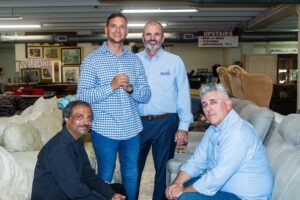
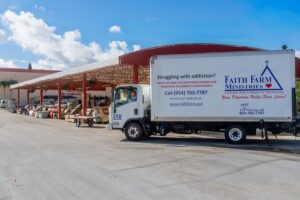
To many South Floridians, Faith Farm Ministries is best known for its white trucks, crisscrossing neighborhoods and picking up donated furniture for its thrift stores. According to Rick Aspden, Faith Farm CEO, that visibility is both a blessing and a challenge. “The public image is that we’re a thrift store — and it drives me crazy,” Aspden said. “Yes, that’s what we do, but that’s not why we’re here.” In reality, the thrift stores are the engine that fuels one of South Florida’s longest-running Christian recovery ministries. In 2026, Faith Farm marks 75 years of providing free, long-term residential recovery for men and women battling addiction, and it’s funded largely by donated usable items and countless acts of generosity.
 At its core, “Faith Farm Ministries is a church with a heart for the hurting,” Aspden said. It is “a Christian ministry whose purpose is the advancement of the gospel of Jesus Christ through the restoration of men and women leading to transformed lives.” Every program, decision and dollar is filtered through that mission.
How it began
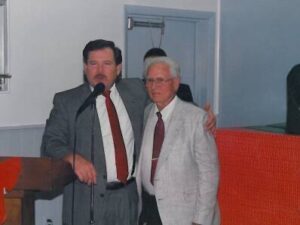
It all started 75 years ago as an act of faith. According to Mike Brown — a board member, former 23-year staff member and assistant to the founder — the ministry’s origins trace directly to the life and calling of Garland Eastham, affectionately known as “Pappy.”
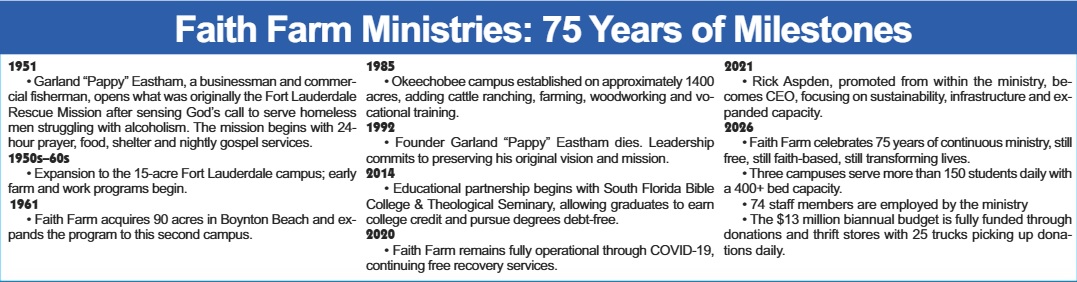
Before founding Faith Farm, Eastham was a successful craftsman and businessman, skilled in upholstery, furniture restoration and even hand-carved antique duplication. He had relocated to South Florida from the Midwest for his wife’s health; however, Eastham’s life took a profound turn when she died. He purchased a boat and worked as a commercial fisherman but felt an increasing burden to help homeless men, many of whom were struggling with alcoholism. Unsure how to proceed, Brown said Eastham prayed for clarity and “asked God for a sign. The next morning his boat had sunk to the bottom [of the bay]. There was no hole, nothing wrong with it at all. He knew then that God was telling him, ‘You’re done fishing. I have something else for you to do.’”
To learn more about the people he felt called to serve, Eastham traveled to New York City and spent time in the Bowery, living among homeless alcoholics and visiting missions, which crystallized Eastham’s philosophy. The work began with a 24-hour prayer chain, and in 1951, Eastham acquired an unfinished building in Fort Lauderdale and opened what was first called the Mission of Prayer, later renamed the Fort Lauderdale Rescue Mission, the legal entity still known today as Fort Lauderdale Rescue Tabernacle Inc.
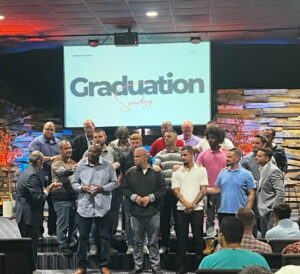
The vision was simple:
- Provide food and shelter
- Require sobriety and participation in nightly church services
- Help men return to society through work and spiritual transformation
Brown explained, Eastham believed real change came only “from the inside out,” through the gospel and not by behavior modification alone.
Shortly after opening the mission, God provided 13 acres of land in Fort Lauderdale, then outside the city limits, where a small nursery operation began. Plants were sold, donations were received, and eventually furniture and household goods were received, repurposed and offered for sale. This grew into the thrift store model that now sustains the ministry, and the presence of that small farm gave the ministry its enduring name: Faith Farm Ministries.
The current program
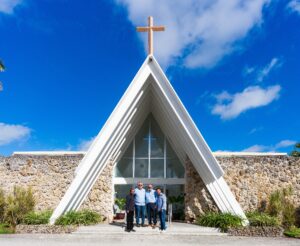 After three-quarters of a century, Faith Farm operates at a scale few realize. Faith Farm employs 74 staff at three campus locations: Fort Lauderdale, Boynton Beach and Okeechobee. They operate a fleet of 25 trucks, collecting donations across South Florida. And while they have a total capacity of 400 beds throughout the ministry, their residential program currently serves about 150 adult men and women they refer to as students.
The ministry charges nothing for its program. “Everything is provided,” Aspden said. This includes food, housing, counseling, education and job training, often for people who arrive with only the clothes they’re wearing.
Students who enter Faith Farm’s recovery program commit to a 10-month residency that is divided into four stages with the option upon graduation to move into an additional year of leadership development and family recovery.
- Orientation helps them get settled and learn about the Lord and how to hear from Him.
- Phase 1 involves counting the cost of their addiction, what it has taken from them and confronting denial. It’s a time to ask, “What has my addiction cost… emotionally, physically and mentally. Where’s my relationship with the Lord and where’s my relationship with my family?”
- Phase 2 involves making amends. It focuses on taking responsibility and beginning reconciliation where possible.
- Phase 3 focuses on inner healing. Often seen as a turning point in the program, Aspden said this is the stage when “everything comes out.” In a structured class environment, they focus on healing. Everything comes out. They “deal with their junk in a no-holds-barred way” then focus on healing the hurts they may have never dealt with.
- Phase 4 focuses on living out their new identity in Christ and reducing the risk of relapse. “Once someone is operating as a child of God, in who the Scripture and the Lord says you are, there is less and less chance of going back to your old ways,” Aspden said.
Upon completion of this 10-month program, Faith Farm offers an optional yearlong leadership track in which men have the opportunity to “partner with the Lord to give back what they got” in the program, mentoring and teaching at Faith Farm and being trained for ministry roles.
Aspden said, “Work therapy is a very intricate part of what we do.” Program participants live on the premises, working 40 hours a week serving the public through their thrift store operations and other micro industries. Working closely with the public often brings out emotions that they can then learn to handle in a positive way through the gospel. It provides real-world, marketable experience for the participants and also generates revenue to make it all work since Faith Farm does not receive any government assistance.
Living in faith
 The relationships developed between program leaders living out their faith alongside those battling addiction are the keystone to Faith Farm’s ministry.
In retrospect, Brown recalls “Pappy” as more of a grandfather to him and a mentor to many. “Pappy never drew a salary. He wore donated clothes, ate with the men, lived in a small house on campus, and kept an open door for anyone who needed to talk.” Brown recalled that Eastham once said about the ministry, “If I’d known it would get this big, I never would have started, but I’m glad God didn’t show me. He just took me one step at a time by faith.”
Today, a new generation of ministry leaders is following Pappy’s example of discipleship, as evidenced by the following alumni testimonies.
Testimonies
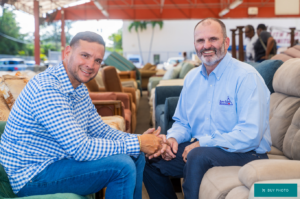
Andrew Auer’s addiction grew out of a turbulent childhood and early work in construction, where drugs and alcohol were easily accessible and normalized. Arrested in 2012 for a store robbery and detoxing in jail, a life-threatening seizure became the moment he says he clearly knew God was calling him to a different life. Faced with the choice of prison or long-term treatment, Andrew entered Faith Farm Ministries — not by coincidence, but through what he describes as God working through the justice system to direct him toward a faith-based program.
Today, Andrew lives in Orlando with his wife and daughter and has remained sober since 2013. He is a state-certified, licensed plumbing contractor, launched his own company, X-Factor Plumbing, and serves as a deacon at St. Paul’s Presbyterian Church, where he mentors others struggling with addiction and volunteers with local ministries.
Auer described the mentorship he received at Faith Farm, particularly from Rick Aspden, as transformational. “Rick didn’t just bring the truth of the gospel; he walked it out consistently,” Andrew said. “He showed me what it meant to put one foot in front of the other as a Christian man.”
Auer attempted recovery before Faith Farm, but nothing lasted. “Other programs didn’t have enough foundation,” Andrew explained. “Faith Farm brought the physiological and psychological together, filtered through Scripture — and that’s what finally stuck… They help you step out of who you thought you were and into the man God created you to be.”
Anthony Marakovitz, an addict for 40 years, began drinking and using drugs at age 15, growing up in the era of “sex, drugs and rock ’n’ roll.” By 2012, he was homeless, consuming a gallon of vodka a day, along with meth, crack and pills, and his life was unraveling until friends intervened and brought him to Faith Farm Ministries.
During a crisis on Christmas Eve 2012 — when guilt, shame and loneliness nearly led him to leave — staff intervened and brought him to a church service that became a defining spiritual moment. “I felt the presence of the Holy Spirit loud and clear,” Marakovitz said. “My whole world changed that day.” He completed the long-term program, stayed on as an intern and spent an additional year teaching and mentoring other men in recovery.
Today, Marakovitz has been sober for more than a decade. He is happily married and is an elder at Calvary Chapel Fort Lauderdale, where he serves as a Celebrate Recovery leader, in men’s Bible study, beach baptisms and counseling. He also owns a successful handyman business.
When asked what makes Faith Farm different, Marakovitz said, “The difference is Jesus. Faith Farm teaches the Bible and trains you to have a personal relationship with Christ, and that’s what lasts.” His advice to others struggling with addiction is, “Don’t leave before the miracle happens. If you stay, God removes the temptations completely — that’s the miracle… Faith Farm taught me what I needed to do. It became the foundation for everything that came after.”
A beneficial partnership
Thanks to a partnership with South Florida Bible College & Theological Seminary (SFBC), Faith Farm graduates who choose to pursue higher education can receive nine credit hours toward completing a degree at SFBC. Dr. Mary Drabik, president of SFBC and vice president of Faith Farm’s board of directors, said that for most Faith Farm graduates who qualify for federal financial aid, if students agree not to take on student loans, SFBC often can scholarship the remaining tuition, allowing them to graduate debt-free. The results have been remarkable. Drabik said Faith Farm graduates have not only enrolled but excelled academically, with several graduating as valedictorians.
A few of the graduates now work at the college. For example, Jeremy Scott completed Faith Farm’s residential program and volunteered for an additional year. During that time, faculty from South Florida Bible College regularly visited Faith Farm. Encouraged by faculty and staff, Scott applied to the college after completing Faith Farm and moving off campus. The transition would not have been possible financially without support. He applied for federal financial aid, and South Florida Bible College covered the remaining balance through scholarships. “There was no way I could have afforded school without that,” he said. Earning a four-year degree in pastoral ministry, Scott graduated in 2020 and was hired by South Florida Bible College, where he now serves as registrar, helping students—many with difficult backgrounds of their own—navigate enrollment, records and academic progress. Scott remains sober and grounded in faith, viewing his work in Christian education as a continuation of what began at Faith Farm.
75 years of ministry
Over 75 years, the ministry has witnessed what Aspden calls countless “miracles” — men and women restored, families reunited and graduates who now serve as pastors, business owners and mentors.
Drabik sees its longevity as the ultimate proof of faithfulness. “Time is the test—the test of time. They’ve been through highs and lows, and they’re still here. Look what God is doing,” Drabik said. “It’s because they’ve stayed faithful to the mission and vision of their founder, ‘Pappy’ Garland Eastham started with 75 years ago. And I think it’s just the beginning. There are a lot of great plans ahead.”
Aspden shared three key priorities the ministry is focused on as it looks ahead.
- More lives transformed: “I want twice as many people in the program as we have right now.”
- Sustainable funding and partnerships: With aging facilities and no government funding, every dollar matters. “Every dollar is a life to us,” he said. He hopes to build a development program and seek key partnership with local churches.
- Infrastructure: From roofs to electrical systems, 75-year-old buildings come with real costs and real needs. The ministry is currently seeking funds to update and maintain their facilities.
After 75 years, Faith Farm remains what it has always been: a faith-driven ministry sustained by obedience, generosity and, yes, thrift stores. As Aspden puts it, every donated couch or $5 dollar book sale is an invitation to “join God at His work” in saving a life.
For more Good News, read the GOOD NEWS January 2026 Issue at: https://digital.goodnewsfl.org/2026/january/