

As the Constitutional Convention finished its work on September 17, 1787, Mrs. Elizabeth Willing Powell asked Dr. Benjamin Franklin, “Well, Doctor, what have we got? A Republic or a Monarchy?” The good doctor answered her with the famous words, “A Republic, Madam, if you can keep it.”
Mrs. Powell’s question is instructive, but also surprising to modern Americans because of what she did not ask. She did not ask if we had a Monarchy, a Republic or a Democracy. At the time of America’s founding, by common consensus, no one would have advocated for a Democracy. For the wise drafters of the Constitution, there were only two, not three, alternative regimes between which to choose. Democracy was not considered a viable option. Why?
Let’s begin to answer this question with a survey of the possible political regimes or types of government. The Greeks, the classical philosophers of political government, examined all possible political regimes and concluded that all forms of government have within them the seeds of their eventual overthrow. The Greeks observed that there were only six possible regimes, three good and three bad. Logically, there could only be the rule of the one, the few or the many. Each of these three political regimes had a good form and an evil form.
Monarchy
Monarchy was the rule of the one. But Benjamin Franklin told Mrs. Powell that Monarchy had been ruled out in favor of a Republic. Why? The problem with a Monarchy is that, while it is possible to have a benevolent monarch, the decision to give such enormous power to one person runs a great risk. A kingdom passes from a king or queen to a son or daughter. While we might have a benevolent or good king, that king could have an evil son. A wise king like Solomon could have a fool for his son, like Rehoboam. A kingdom could be ruined suddenly—in a single generation. The framers ruled out a Monarchy because a good king like George Washington could become a tyrant like King George.
They chose instead to construct a Republic, which implied a deliberate rejection of both Tyranny and Democracy. We have seen the inherent issues with a Monarchy, but why did they reject the rule of the many, a Democracy?
Democracy
The Greeks did not invent Democracy, as is often mistakenly claimed. But they observed it very carefully. They concluded that it too has a serious flaw that inevitably leads to its own particular social ruin. What is that flaw? A Democracy inevitably leads to financial default, government bankruptcy and social upheaval. It creates factions, promotes corruption and results in a ruinous, strife-filled social crisis. Unfortunately, this is a feature of Democracy, not a bug. Democracies are all on a road to ruin because they can never truly balance a budget. Why?
The Greeks observed that in society there are always more poor than rich, more debtors than creditors. Wealth is power, and it tends to concentrate in the hands of the few rather than the many. But in a Democracy, the multitudes, who are poor, have the power of the vote. Social strife is inevitable in such a regime. The wealthy few find ways to manipulate the vote tally. The multitudes of the poor suffer under personal debt. Debt leads to inflation and higher taxes, which further oppress the poor, who become desperate for immediate relief. The candidates who promise the most relief and the least pain inevitably win elections in democracies. A foolish Santa Claus is always favored over a wise Grinch. Assets accumulate among the few and protect the ever fewer rich from inflation as the government inevitably debases the currency. Eventually, the poor are crushed. Debts must be defaulted upon, and entitlements, annuities and pensions are radically reduced or even repudiated altogether. Insurance too is unobtainable, and Democracy suddenly and spectacularly collapses.
The Greeks understood that Democracy creates conditions that invite the emergence of a powerful tyrant who promises to stop the chaos. The fearful and desperate people settle for a “Savior” who demands total power to solve the problems of the many factions in the state. Fear spreads. Liberty dies. The Tyrant comes.
The Greeks insightfully imagined that the three good and three evil regimes could be arranged on a kind of “wheel of regimes.” The typically bloody movement from an “evil” Democracy to an “evil” Tyranny was called a “revolution” of that “wheel.”
We Christians have a two-fold vision. We vow our love to our earthly country. We work and pray that God will mend her every flaw, and “guide her through the night with a light from above.” But we have heard of another Country, and so we do our service to America in light of a better, heavenly hope.
A Republic with checks and balances
Why did the framers of the Constitution choose a Republic, the good form of the political rule of the many? This regime mediating between a Monarchy and a Democracy offered the best prospect of the greatest liberty with the greatest possible longevity. The Constitution created a Republic, a mixed government engineered to incorporate checks and balances to restrain the destructive tendencies of both Tyranny and Democracy. These checks and balances put an institutional restraint on the three powers of government: Legislative, Judicial, and Executive. A Monarch or a Tyrant held all those powers. He announced the laws; he interpreted their meaning; and he enforced them. A good king would use these powers in the service of the commonwealth, or the public. But a Tyrant would use them to serve his own pleasure or self-dealing.
The Republic that the US Constitution created had institutional checks on the executive office of the President. He could propose laws but not enact them. He could execute the laws but not interpret them. That feature restricted the threat of a Monarchy. Likewise, the President was chosen by an Electoral College, which was a deliberate restraint on Democracy, which protected the smaller states and thus served to promote social cohesion. The institution of the Senate too restrained Democracy. Wyoming, for example, would have the same number of Senators as California and thus the same influence in that chamber of Congress.
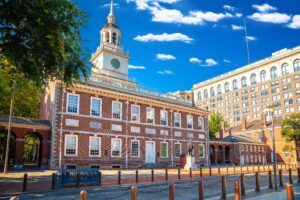
The framers of the Constitution wanted to preserve the conditions of liberty above all. Their imperfect circumstances led to moral compromises that they themselves failed to resolve, most notably their decision to permit the continued existence for a time of the abhorrent institution of slavery. But the drafters did what they could within the limits of their time and political realities. They humbly recognized that their work was imperfect and so incorporated a means of Constitutional amendment.
They also knew that public liberty was incompatible with social license. Only a virtuous people could remain free. A Constitution could not guarantee virtue. The framers relied on the church pulpits to teach those lessons. Again, they did only what they could. In fairness, they did more than they could have ever dreamed.
America at 250 years would no longer be recognizable to Dr. Franklin and the framers as a Republic. In reality, we no longer even think of ourselves as a Republic. We have not “kept” the Republic, as Franklin warned Mrs. Powell. We have long ago transitioned to a full Democracy. To ask where America is today as a Democracy is a different question entirely. The answer to the question about the future prospects of our individual and collective liberty is bleak, according to all historical political precedent.
But there’s another country
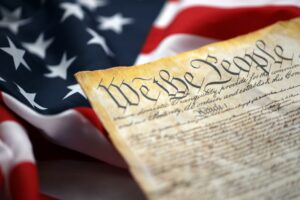
So how does a Christian, aware of these political tendencies all around us, face a future that predicts much social suffering under threat of an emergent Tyranny? The answer in every case and in every regime is the same—with great Hope!
We have a vision, given by our Lord’s own Apostles, of a Country where there is no difference between Jew or Gentile (Greek). This biblical vision is the most radically anti-racist community ever envisioned, where everyone is understood to be created with the dignity of possessing the image of God himself. There is neither slave nor free, but one community that is being liberated from the bondage of sin and death. There is neither male nor female, but everyone shares in the dignity of being called children of God. We are all one in Christ Jesus (Galatians 3:28). There is no longer rich or poor, but everyone supplies the needy out of the rich abundance of their love of God (Acts 4:32). There are no factions and thus no politics, because rich and poor alike share in a salvation that is a betrothal covenant to the royal house of David. Christ himself makes most royal all his people, and even the least among us is accorded the courtesy of kings!
In our New City, the outcast is brought in; the downcast is raised up. Our agenda is simply to love and serve one another. Our program is to go about doing good like our Sovereign King. Like him, we wash feet. Like him, we protect the widow and orphan. Like him, we redeem and esteem the broken and the lost. And like him, we lay down our lives for others. We share with everyone our hope of the Heavenly City and watch in joy as her shining boundaries ever more and more increase.
Our Scriptures have told us of another Country, a Heavenly City. The earthly city was founded by Cain, who murdered his brother. The Heavenly City was founded by a Man who laid down his life so his brothers might live. Saint Augustine described these two cities. He said the earthly city is founded on love of self even to the despising of God. The Heavenly City is founded on the love of God even to the despising of self.
We Christians have a two-fold vision. We vow our love to our earthly country. We work and pray that God will mend her every flaw, and “guide her through the night with a light from above.” 2 But we have heard of another Country, and so we do our service to America in light of a better, heavenly hope. In the beautiful words of the hymn, “I Vow to Thee My Country” by Sir Cecil Rice Spring:
And there’s another Country I’ve heard of long ago;
Most dear to those that love her, most great to those that know;
We may not count her armies, we may not see her King;
Her fortress is a faithful heart, her pride is suffering.
And soul by soul and silently her shining bounds increase,
And her ways are ways of gentleness, and all her paths are peace. 3
To listen to “I Vow to Thee My Country” by the lyric tenor Rahim Karimloo, go to: https://www.youtube.com/watch?v=b1auKiBFv2M
© Dr. Warren Gage 2026.
Dr. Warren Gage is the President of Watermark Gospel (WatermarkGospel.com), a nonprofit ministry that aims to show the world how to find Jesus in every story of the Bible. He holds a Th.M. from Dallas Theological Seminary, a J.D. from SMU School of Law, and a Ph.D. in political philosophy and literature from the University of Dallas. He worked for twelve years as a trial attorney and was national counsel for a Fortune 500 defense contractor in Washington D.C. For the next twelve years, he was a Professor of Biblical Studies and of Classical Studies at the graduate level. He is a prolific author, whose books and articles are available on DrWarrenGage.com.
Book 8 of Plato’s Republic is perhaps the most devastating analysis of Democracy ever written. He sets forth the additional argument that Democracy itself is at war with nature, and as such, can never lastingly endure. His argument constitutes a most enlightening critique of modern democratic regimes.
2 “God Bless America” by Irving Berlin.
3 “I Vow to Thee My Country” by Sir Cecil Rice Spring. Music by Gustav Holst.
For more Good News, read the GOOD NEWS July 2026 Issue at: https://digital.goodnewsfl.org/2026/july/#1