
One hundred years ago, as Fort Lauderdale was still finding its footing, The Salvation Army of Broward took root with a simple mission to serve those in need facing hunger or homelessness, while strengthening the community. Known for their iconic Red Kettles manned by cheery bell ringers who seek donations for the needy at Christmastime, The Salvation Army’s facilities and services are extensive and far reaching.
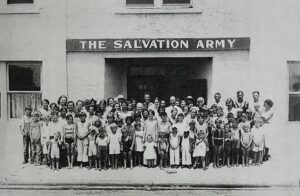
Part of an international movement that began in 19th-century England, The Salvation Army was founded by William and Catherine Booth who decided to take the gospel beyond traditional church walls and into the streets of London, where they preached to the poor, homeless and marginalized. The name, “Salvation Army,” reflects their vision of a disciplined force fighting spiritual and social injustice, a culture that remains today. The movement spread rapidly around the world and is now present in 134 countries.
As The Salvation Army marks its centennial in Broward, it honors the pioneer families and civic leaders whose generosity laid its foundations, charting a course for the next hundred years under the leadership of Major Juan Guadalupe, and guided by a strong, engaged Advisory Board.
In Broward the need is growing fast. According to the Florida Council on Homelessness’ 2025 Point-in-Time count, 2,636 individuals are experiencing homelessness in Broward County, including both sheltered and unsheltered residents. The figure represents a nearly 7% increase from the previous year and underscores why The Salvation Army’s mission remains critical.
A holistic approach
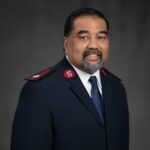
A Salvation Army officer with more than 25 years of service, Guadalupe arrived in Broward in June 2023 after holding seven leadership appointments across the Southeast. A Master of Divinity graduate, he spent 17 years as a pastor balancing ministry with multiple jobs prior to joining The Salvation Army, including missionary work in Venezuela.
Guadalupe said he was drawn to The Salvation Army by their holistic approach to ministry. “I was working on my master’s degree in Chicago when a professor took our class to the Salvation Army,” Guadalupe said. “I realized they were a church, but they were also feeding people, clothing people and serving those on the street. I went home and told my wife, ‘This is incredible.’ We started praying, and a few months later the door opened.”
According to Guadalupe, Salvation Army officers undergo two years of training at The Salvation Army College in Atlanta, Georgia, spending the first year on Bible classes and the second year in social services, administration, financial and fundraising classes in preparation for management. Once assigned a command, Guadalupe said he gets paid “just a modest stipend along with the provision of a house and car,” making less than many on his staff.
“For me, faith is not separate from leadership,” Guadalupe said. “I’m a pastor first. When duty calls – when someone is in the hospital or in crisis – that comes before any meeting, every time… The hardest part as a Salvation Army officer is to keep the balance, to make sure you’re taking care of the congregation, doing God’s will, and at the same time handling the other part: fundraising, administration, programs, staff.”
According to Bob Moorman, longtime Salvation Army of Broward Advisory Board member and owner of Carroll’s Jewelers, “The mission of The Salvation Army is God-centered. Feed the hungry, clothe the naked, house the homeless—that comes straight out of the Bible. That’s what Jesus Christ taught, and that’s what the Salvation Army does. They put the words of Jesus into physical action.”
Expanding services for a growing need
Bringing with him a business mindset from years in retail, Guadalupe also had a strong commitment to stewardship and community engagement. He arrived with a clear set of priorities: to stabilize and strengthen the organization financially by growing reserves and trust funds, refocus resources on mission-driven programs that directly serve people in need, build strong leadership infrastructure through an engaged Advisory Board to ensure continuity beyond officer transitions, and position the Salvation Army as a trusted and visible community leader among local government, partners and donors.
The Salvation Army of Broward County’s expansive facilities and services include
- The Administrative offices, emergency shelter, dining hall and food pantry, at 1445 W. Broward Blvd., which includes the Open Door Shelter,
- Plymouth Colony Transitional Housing apartment complex for families in Hollywood,
- The Adult Rehabilitation Center, 1901 W Broward Blvd, supported by
- Thrift stores located at five locations,
- The Corps Community Center, at 100 SW 9th Ave., home to a thriving church.
- The Red Kettle Campaign at Christmas that raises funds for families in need.
- The Angel Tree program, that provided holiday gifts for 4,330 underprivileged children in 2025.
- Case management with a focus on economic empowerment and employment.
- Emergency Disaster Relief and more!
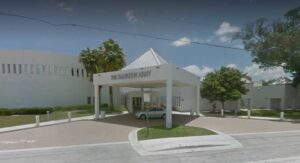
One of the key initiatives under Guadalupe’s leadership is the planned expansion of the Open Door Shelter, a low-barrier entry point for individuals experiencing homelessness. The expansion, which would add approximately 49 to 50 additional beds, grew out of internal discussions led in part by Lilly Gallardo, senior director of social services.
The project is designed not only to increase overnight capacity, but also to serve as a gateway, connecting individuals to case management, transitional housing options and long-term stabilization. Funding for the expansion includes some federal support already secured, with planning and design work underway.
The need for such services has intensified over the decades. The Salvation Army of Broward now operates with an annual budget approaching $13 million, making it one of the largest Salvation Army entities in Florida with the capacity to house up to 400 people on any given night. Programs include emergency shelter, transitional housing, food assistance, rehabilitation services, case management and spiritual care.
For Guadalupe, stewarding resources well is a priority. “If I’m going to invest $100, I want to get $200 or $300 back, not for myself, but for the mission,” he said. However, many people underestimate the scale and cost of their work.
“We help thousands of people on a yearly basis, feeding them, clothing them, housing them. And sometimes people don’t realize how much effort and money it takes to operate. For instance, Plymouth Colony transitional apartment complex has 36 apartments for families that depend on donations and grants to operate a more than $1 million budget each year to cover the costs and try to help get families into permanent housing after one or two years. We also run a shelter with almost 200 beds, feeding them, clothing them, showering them, and hiring case workers that help them find a job, find a place to live; it’s a big process.”
Supported by community pillars

“The presence of the Salvation Army is, I think, one of the unrecognized and noble heroes of Fort Lauderdale’s development,” said Curt Nichols, a Fort Lauderdale native, former senior vice president at City Furniture and executive consultant who currently serves as chairman of The Salvation Army Advisory Board.
“I’m looking out my window counting eight towers and four different cranes going up downtown. You can’t build – none of that happens without the Salvation Army helping those that are homeless get out from in front of those buildings, away from the valet stand, away from the restaurant, the bar. If these neighbors of ours – the homeless – did not have the Salvation Army, that’s where they would be camped out, looking and soliciting for money. And trust me, the vacancy of those towers goes up if there’s not a Salvation Army.”
Area commanders typically rotate every 3 to 8 years; however, the Advisory Board is the constant in Broward County, led by the Army’s traditions, processes and policies that have helped sustain it.
“Some of the titans and pillars of our history in Broward County and Fort Lauderdale were the original builders of this board,” said Nichols. “Now myself and others are only trying to push this on to the next generation.”
Nichols pointed to a long line of civic and business leaders whose involvement helped shape the organization alongside the growth of Fort Lauderdale, names likes Mike Jackson, and Gail Butler, of AutoNation, and Steve Halmos, along with a number of families and foundations that have been friends of the Salvation Army over the years.
Earliest among them was Ivy Stranahan, a pioneering suffragist and early advocate for the Seminole Tribe, who served as vice chair of the Salvation Army Advisory Board in the 1930s. Stranahan was known for providing food, clothing and emergency aid during times of hardship, including the aftermath of the Great Miami Hurricane.
Nichols mentioned H. Wayne Huizenga, the entrepreneur behind Waste Management, Blockbuster Video and AutoNation, whose family foundation funded the Corps Community Center that bears the family name on Broward Boulevard.
Other key figures include Theodore “Ted” Friedt, a businessman and philanthropist who was instrumental in raising funds for the Salvation Army’s headquarters; and Elliott Barnett, a leading attorney and arts patron, who played central roles.in the 1980s.
Nichols praised the organization’s operational discipline, noting that its efficiency and standard operating procedures rival those of top-performing for-profit companies.
“I’ve sat on five to seven other local and statewide boards,” he said. “None of them operate at the level the Salvation Army does. Their ability to maximize every dollar is best in class.”
A historical perspective
Former area commander Lt. Col. William Crabson, who served in Broward from 1981 to 1988 spearheading the capital campaign for the current administration building and later led the Salvation Army College in Atlanta, offered a broader historical perspective on why the organization has endured.
“Everything you see was paid for by people who would never use the services themselves,” Crabson said. “No matter their church affiliation or business background, they gave generously because they believed in helping others. That speaks volumes about the generosity of this community, the compassion of the people who live here and its widespread faith community.”
Reflecting on changes over the decades, Crabson said the scale and complexity of need has grown dramatically.
“The rate of addiction issues has multiplied many times over,” he said. “That creates a cascade of mental health challenges, so serving people who live on the edge today is far more complex than it was 40 years ago.”
Crabson also pointed to the quality of leadership as a key reason the Salvation Army has lasted 100 years.
“People like Major Juan Guadalupe, and other officers, Capt. Pierre, and Major David Sams, who is in charge of the huge drug recovery program supported by our family stores – these people are highly dedicated, committed, compassionate Christians whose ministry is in the Salvation Army. We’re fortunate that God has brought them here,” said. Lt. Col. Crabson.
Future plans
 Looking ahead, the Salvation Army of Broward plans to strengthen donor development and endowments to reduce reliance on government funding, expand shelter and transitional housing capacity and hopes to launch a telehealth medical clinic for aging and medically vulnerable clients.
“We’ve never had a population experiencing homelessness that has been so aged and suffering from disabilities and medical issues like we do today,” said Guadalupe. Telehealth would allow clients to connect directly with doctors for diagnoses and prescriptions without unnecessary emergency room visits, but the program’s future depends on partnerships. “The provider side is the linchpin — how much support we can get from the medical community. That’s what will determine how far we can take this.”
As they honor those who came before and paved the way, Guadalupe said. “We also have a responsibility to make sure the Salvation Army remains strong, relevant and ready to serve this community for the next 100 years.”
Celebrations
The 100th Anniversary Festivities will be held in May during National Salvation Army Week, beginning with a concert on Friday, May 15 featuring the Salvation Army Brass Band. A Centennial Celebration Banquet will be held on Saturday, May 16th at the Corps Community Center, featuring keynote speaker Lt. Col. William Crabson, who served as area commander from 1981 to 1988 and launched the building. And Ron Busroe, former area commander, will be preaching during a special Sunday morning service.
The Salvation Army of Broward County: Centennial Timeline
1926 – Salvation Army operations launch in Fort Lauderdale, in February, under the leadership of Captains Mr. & Mrs. Jesse Wycoff from Miami. The first structure was a large tent pitched at the corner of SW 2nd Street & SW 2nd Ave. The Great Miami Hurricane struck the region in September, destroying the tent, piano and benches, along with most buildings in Broward, killing dozens and rendering many homeless. Salvation Army personnel rolled up their sleeves and began helping feed, clothe and house the destitute. Throughout the storm clean-up and the late 20’s, they based out of different locations in Hollywood and then back in a hotel space on Brickell Avenue in Fort Lauderdale before securing a permanent structure at 21 SW First Ave. The Hurricane, regional land bust, and the Great Depression unleashed in 1929 reinforced the timeliness and deep value of The Salvation Army’s efforts in Broward. Founding board members included Mayor R.G. Snow, Roy McJunkin, Ivy Stranahan and other Broward pioneers.
1931 – Community comes together, via local Trade Union, to expand and erect the building on 1st Ave.
1950 – Welfare Center purchased and put into operation on Old Dixie Highway.
1956 – Corps Community Center (‘Citadel’) for worship and community service constructed at newly purchased property at 9th Ave. SW and Broward Blvd. (site of current Corps Community Center).
1965 – Rehab Center opens on Broward Blvd near the 95, eventually named Adult Rehabilitation Center.
1967 – Shelter space, soup kitchen and Area Command offices opened on Broward & 14th.
1984 – Expanded outreach in Hollywood leading to The Home Front shelter for runaway teenage girls.
1990 – Greatly expanded shelter & Area Command constructed at present location: 1445 W. Broward.
1993 – With anonymous seed donation of $1m, Plymouth Colony transitional housing for families commences in Hollywood, housing 32 families for 12-24 month intensive case management program.
2003 – New Corps Community Center constructed over former site, three times the size of former facility, including state-of-the-art gymnasium.
2014 – Open Door Shelter – a low-barrier, low-threshold shelter space opens as addition at Area Command, housing an extra 38 individuals, nightly, and becoming a strategic portal into other services.
2024-25– First two Red Shield Regatta single-event fundraisers, hosted and underwritten by JM Family Enterprises, Inc. in Deerfield Beach, enabling The Salvation Army to net over $200k each year.
2026 – Centennial year plans underway to expand the Open Door Shelter by 49 additional beds.
For more Good News, read the GOOD NEWS February 2026 Issue at: https://digital.goodnewsfl.org/2026/february/#1