

In the United States, higher education has become a growth industry. Since 1970, the number of college students has more than doubled. However, it seems that Americans cannot quite agree on what a college should do and what type of graduate it should produce. Some Americans want universities to be merely job-training institutions. Others want them to be hotbeds of political activism. Yet others want universities to produce culturally literate citizens.
For Christians, this raises the question: “In God’s design, what is a university for?” More to the point of this article, “What is a distinctively Christian university for?”
The short answer is that the proper purpose of a Christian university is to educate its students for witness. As God’s people, college students are called to witness to God’s goodness, his design for human flourishing, and his desire for human beings to be grateful learners, constructive citizens and productive workers.
The slightly longer answer is that Christian education is a unique and significant endeavor to which the Bible’s grand story speaks. To that subject we now turn.
The Bible’s storyline in relation to higher education
The Bible’s opening narrative has implications for Christian higher education. In the first two chapters of Genesis, we learn that God created the world not only to have different kinds of animals and vegetation, but also to have different “kinds” of culture. Thus, as human beings we enjoy culture in various forms such as art, science, politics, entertainment, sports, business and — to the point of this article — education. Each kind of culture has its own unique purpose. Higher education is no exception.
What, therefore, is the purpose of education in general, and higher education (colleges and universities) in particular? The purpose of education in general is to give students knowledge and skills that will help them mature intellectually, spiritually and vocationally, so they can be effective ambassadors of Christ. Thus, the mission of a Christian university should help students mature in this way by offering a curriculum that aligns with the Christian worldview.
Of course, in a fallen world, many historically Christian universities (e.g. Ivy League institutions) do not strive to unify their courses around a Christian worldview. For example, a given university might hire professors who actively undermine the historic Christian faith. Or it might be that a university has inadvertently hired professors who do not have a fully formed Christian worldview themselves and thus wouldn’t know how to frame their courses in light of Christian teaching. Under these scenarios, the university’s educational culture is diminished and the institution suffers.
We must pray that our evangelical universities unify their mission, curriculum and faculty around basic Christian truths. They cannot be content to deliver an essentially secular education with a few Christian insights tacked on here and there. Instead, they must consciously hire and develop faculty and administrators who frame their subject matter from within the Bible’s story about reality and who norm their lectures and research with the truths of scripture.
Christian professors in the university community
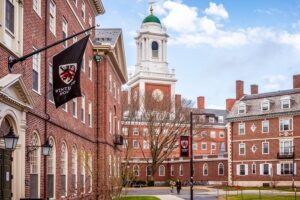
In America’s increasingly secular culture, the work of Christian professors may very well be mocked or excluded from broader educational discourse. In fact, this often happens. Consider the point made by John C. Green, political science professor:
“If a professor talks about studying something from a Marxist point of view, others might disagree but not dismiss the notion. But if a professor proposed to study something from a Catholic or Protestant point of view, it would be treated like proposing something from a Martian point of view.”
Similarly, historian George Marsden writes, “The fact is that, no matter what the subject, our dominant academic culture trains scholars to keep quiet about their faith as the price of full acceptance in that community.” Thus, Christian professors will find it challenging to introduce their ideas to the broader university community.
The secularizing of American higher education — and the recent antagonism of the university community against the Christian faith — is distressing. Consider three ways this is seen. One, modern secular universities educate most of America’s students and, although aspects of their education are quite valuable, the graduates of those institutions are never taught to frame their subject matter within a proper understanding of overarching reality. Two, even worse, many students graduate thinking the Christian faith is not only irrelevant but backwards or even bigoted. Three, some of these students graduate with their faith intact but later become professors themselves and produce scholarly work that unintentionally is conformed to this world. There are, to be sure, Christian professors on the front lines of secular education, revealing gospel truth to their students. But their job is not an easy one and often goes unnoticed.
Faithfulness and excellence for the sake of witness
In light of God’s design for higher education, and the significance of colleges and universities in the Christian mission, let us pray for our Christian university administrators, teachers and scholars that God will enable them to fulfill their vocations with faithfulness and excellence. Regarding faithfulness, let us pray that God will guide them to frame the teaching-and-learning process in light of the Christian worldview. In The Idea of a Christian Society, T.S. Eliot writes, “The purpose of Christian education would not be merely to make men and women pious Christians… A Christian education must primarily teach people to be able to think in Christian categories.” Regarding excellence, let us pray that God will guide them to be excellent in their classroom instruction, their scholarly publications and their public speaking opportunities.
Dr. Robert J. Pacienza is the Senior Pastor of Coral Ridge Presbyterian Church (Fort Lauderdale, FL) and the CEO and President of Coral Ridge Ministries.
For more Good News, read the GOOD NEWS May 2026 Issue at: https://digital.goodnewsfl.org/2026/may/